Benvenuti

This website will give you a chance to explore WWII and the Holocaust as it affected the country of Italy and it's citizens.
The Rise of Fascism and Mussolini
Understanding history is essential to creating a healthy future. This first portion is dedicated to history, to fully comprehend the lives of those who have survived.
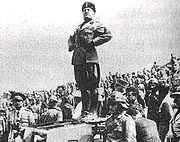
The Black shirts along with Mussolini marching towards Rome

Benito Mussolini was a socialist from a young age. Born July 29th, 1883 Benito was named after a Mexican revolutionary Benito Juarez. He began his political career as a writer. Avanti was an established socialist paper, which he became the editor of soon after finishing schooling. This Milan newspaper was popular among Italian socialist, but Mussolini soon began to voice his opposition to Germany in World War I. This infuriated socialists and he was no longer a well received writer. Mussolini began his own paper, Il Popolo d’Italia. He still felt as though there was more he could do, and once Italy joined in the fight against Germany he enlisted in the Italian Army. He gained the rank of Corporal, an equal rank to that of Hitler. He was discharged after shrapnel wounds.
In 1919 Mussolini and several other veterans founded the National Fascist Party. The party grew in popularity and adopted the Roman salute. The Black Shirt militia, camicie nere, was created. A group of armed veterans, with full support behind Mussolini and his fascist ideals. By October 27th, 1922 this group of former soldiers, officers, and fascists had grown to nearly 200,000 for the March on Rome.
Mussolini organized a three day March through Rome with his camicie nere group. Within those three days Mussolini showed King Vittorio III of his power and his determination to rule. On October 28, the King handed over power to Mussolini, and by the 29th he was ordered to get his cabinet in order. He had reached legal power over the Italian government. Mussolini kept pushing for full control with the iron fist of the fascist party behind him. June 10, 1924 marked the full dictatorship of Benito Mussolini. He earned the nickname, Il Duce, meaning 'the leader'.
Restoring the Roman Empire
Mussolini's main goal was to restore the power and strength of the Roman empire, appointing himself as Caesar. We can see his initial intentions from and article he wrote for the Il Popolo.
"For the last hundred years, the Germans have been poisoned by a constant apology of the fair haired race, the only one capable of creating and propagating Kultur in a decaying Europe.The Empire was to be the instrument for this work of salvation. But the Empire, as it tries to spread, is discovering the limitations of its power. In trying to dilate, it dies...Germany must be crushed. And she can be crushed quickly with the help of Italy. The giant has created a monstrous machine - militarism- to ensure his dominion over all peoples."
His rise to power began in an effort to 'crush' Germany and become the world's strongest power. He began to educate children in the ways of fascism. The boys were taught to fight, the would grow to be soldiers. The girls were simply there to reinforce their race, and procreate. While dreaming of his 'Empire' Mussolini created the Rome- Berlin Axis by invading Abassinia in October 1935. This began his relationship with Adolf Hitler.
Hitler was at the head of the strongest power. Although Germany and Italy were allies, Hitler did not despense his war plans. The two leaders appeared to be friends in the public eye, but Mussolini did not trust Hitler.
In retaliation of Germany's secrecy Mussolini declared an invasion on Greece. However, allies successfully invaded Sicily, and Germany was called to rescue Mussolini. The King finally stepped in and Mussolini was captured, arrested, and placed in jail. He later escaped to Germany, and received advice from his allies. Hitler suggested he be placed in Northern Italy 'in power' as a German puppet. Mussolini refused to admit defeated and disguised himself as a German soldier attempting to flee to Austria. Mussolini was captured shot along with his mistress and hung upside down in the Piazza Loreto in Milan.
Mussolini did not begin this war but he was an integral part. His desire to gain power overweighed his actual intentions. Thus causing him to lose power. In a 2003 interview the current Italian Prime Minister Silvio Berlusconi was quoted saying, the fascist government of Benito Mussolini "never killed anyone". History speaks differently. It has been documented that to control political opposition the black shirt militia force fed them castor oil. This was a humiliation tactic, as castor oil majorly lessens the control of bowels. Mussolini also attempted to cover up the murder of Giacomo Matteotti, a socialist deputy suggested the annulment of his elections. Amerigo Dumini, a member of the black shirt militia, was sent to jail for 2 years for Matteotti's murder. But the largest killings originated in the Italian concentration camps.
Italian Concentration Camps
These camps are rarely mentioned in history, as they were a much smaller scale then those of the Germans. There was also less mistreatment of the prisoners.
There were 23 camps but most were dedicated to men who resisted the Italian occupation army or women and children who livd in villages suspected of sympathizing with the resistance.
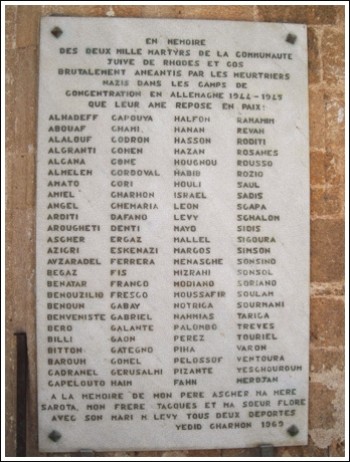
The most infamous of the Italian camps were Rab, or Arbe located off the coast of Croatia. The next was Rhodes (Island), most of its prisoners were shipwreck survivors. Mostly Jews with visas to Paraguay, along with come Czechoslovakian's. They were interned there until the camp was overtaken by the Nazi's in 1942. They were then transferred to another camp within Italy.
Below is the entire list of those who were transferred from Rhodes.

|
deported_1944.pdf Size : 0.102 Kb Type : pdf |
Testimonials:
RAB ( an Italian camp)
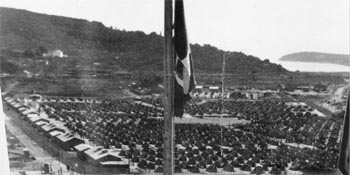
Anton Vratusa a Yugoslavian man was imprisoned in one of Italy's worst concentration camps, Rab, better known to Italians as Arbe. Rab is an island of Croatia that was taken over by the fascist party of Italy.
Vratusa remembers hearing the Italian soldiers standing outside his open air tent yelling: "Tutti fuori, anche morti!" (Everyone out, even the dead!)
The now Yugoslavian ambassador for the United Nations recalls the four camps within Rab and the last place prisoners referred to as the fifth camp. The fifth camp was a cemetery where the starved, ill, and tired finally went to be buried. He goes on to describe the thousands of open-air tents all surrounded by barbed- wire. There was little food and even less water.
Vratusa said he believed the Italians intentions were to kill all of them by starving them to death. In most camps prisoners never got more then 1,600 calories a day. Just to put that into prospective the average male is advised to eat around 2,300 calories a day. They were given inadequate clothes especially during the winter months. Many perished solely on the bone chilling cold alone. This camp held 10,000 people until it was liberated in September of 1943.
By 1943 it is estimated that close to 2,000 people died in Rab alone. Over 100 of those deaths were children 10 and under. The children and women tended to perish first because of the harsh conditions.
The Jews were separated from the others in this camp, and treated much better. They were fed better, got to listen to the radio, and read the newspaper. The Jews finally banded with the other prisoners and formed a military against the Italian guards and over threw them.
Primo Levi (an Italian in a German camp)
A Jewish Italian chemistry student studying at the University of Turin. In 1943 Levi was captured and brought to Auschwitz. He wrote two books on featuring his life and the journey he took during this world war.
His first book Survival in Auschwitz recalls his life in the German camps. Levi depicts his travels to the camp, the way the German's made them stand in the cold train's box car for hours with only a bucket for waste, no food, freezing conditions. Then to be shuttled out in two lines, if you were lucky you chose the line that did not lead to the gas chambers. The others were left to be stripped , shaved of all their hair, and branded with a number that was to become their new and only identity.
Levi recalls a little girl, Emilia. He describes her as a "curious, ambitious, cheerful, and intelligent" 3 year old. She was sent to the gas chambers. From the very beginning Levi lets you know his story is that of truth. He seems to have an interesting way of telling the story. Sometimes leaving the reader in a fog. He is not harsh, he is realistic. This book really creates imagines within your mind. You feel as though you are on this journey with him. Another way in which we , the reader, get to accompany him is within his relationships. Throughout the novel he encounters many people. Only one of which we know survives.
Primo's account of the Holocaust was such a strong story. Below is an interview posted from youtube.com. This is an interview conducted while Levi returns to Auschwitz in 1983.
The After Math
15% of jews were killed in Italy during the war
Over 6 Million Jews were killed during the Holocaust years of 1939-1945
In Majdanek, on 3-4 November 1943, between 17,000 and 18,000 Jews were killed in one day as part of a mass shooting. The event was called Erntefest (‘harvest feast’) and included similar actions all around the Lublin District. More than 40,000 Jews died as a result
44,000 Jews in Italy and Rhodes. By the end of the war, about 8,000 of these Jews died in German death camps.
Neorealism Period, & Influential films
Roma, città aperta (Roberto Rossellini, 1945)
Sciuscià (Vittorio De Sica, 1946)
Paisà (Roberto Rossellini, 1946)
Germania, anno zero (Roberto Rossellini, 1948)
Ladri di biciclette (Vittorio De Sica, 1948)
La terra trema (Luchino Visconti, 1948)
Bitter Rice (Giuseppe De Santis, 1949)
Stromboli (Roberto Rossellini, 1950)
Bellissima (Luchino Visconti, 1951)
Umberto D. (Vittorio De Sica, 1952)
I Vitelloni (Federico Fellini, 1953)
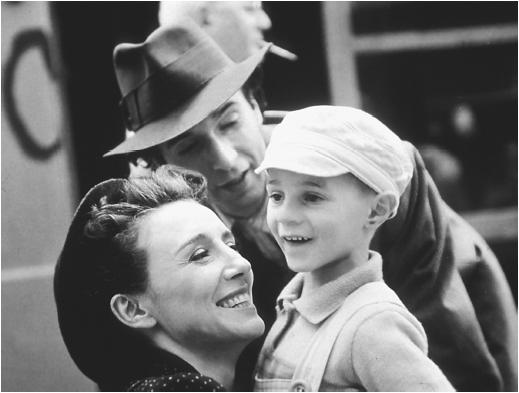
La Vita E' Bella (Roberto Bengini, 1998) (pictured below)
 U.S. HOLOCAUST MEMORIAL MUSEUM
 YAD VASHEM HOLOCAUST MEMORIAL (ISRAEL)
 THE ANNE FRANK HOUSE
Monuments
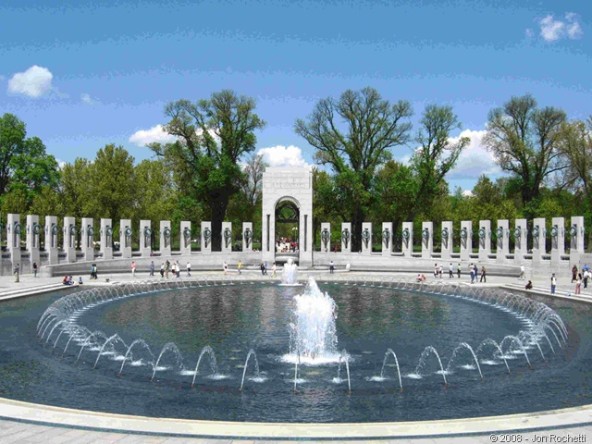
Washington DC Holocaust Monument
(above)
How We Remember the Holocaust Today
National remembrance day in USA
Taking history to the street
"Italy does not forget. We still feel shame that this occurred in our country. This is why every year we read the names of the Italian victims of the Holocaust on the sidewalk in front of the Consulate General"
January 27th the same day in 1945 that Auschwitz was liberated.
While over 6 million Jews perished in Europe during WWII New York has become one of the most Jewish populated areas in the world. It is also the second most Jewish city outside of Israel. The Italian council general in New York has organized a movement to help us remember and honor those lost during the war. On January 27th, for an entire seven hours the council will read the names of the Italian victims of the Holocaust on the sidewalk in front of the Consulate General on Park Avenue. Starting promptly at nine a.m. “Beginning at 9:00 a.m. for about seven hours there will be a relay of personalities and anonymous Italian,American, and world citizens who will read the names of people who lived like us and whose existence was cut short by other men like us.” The Italian Consulate began this recognition in 2009, thus marking this January as the 2nd annual year. This was all made possible by the Centro Primo Levi, the organization for Jewish culture in New York that is dedicated to Primo Levi, the author who explained the brutal reality of the concentration camps to many of us.
For the first time in Italy, on January 28th German artist Günter Demnig has placed 30 Stolpersteine (stumbling stones) near the houses from which Jews, soldiers, and political activists have been deported.
Exhibition marking the 65th Anniversary of the Liberation of Auschwitz-Birkenau Marcello Pezzetti (Italian delegate of ITF) and Bruno Vespa(journalist) organized the exhibition "Auschwitz-Birkenau" in Rome. A section of the exhibition was exposed in the Senate.
